2026 Hong Kong Budget AI Policy Analysis: How to Obtain Funding? What Are the Benefits for SMEs?
After learning how to set up a company and find initial customers, one of the most common challenges faced by SME owners and new entrepreneurs is not knowing what government subsidies are available to apply for. They hear about "AI transformation" but aren't sure if these new technologies offer real value for their business. How much would an upgrade cost? Today, we're introducing the freshly released "Hong Kong Budget AI" policy and funding resource guide. After reviewing the details of these policies and funding options, you can seamlessly transition your company into the AI era at a pace and budget that suits you.
This year's Budget is filled with a strong sense of technology. Facing a global economy entering a transformation period led by Generative AI, the government has unveiled an ambitious technology development blueprint. The themes of the entire Budget include "Innovation & Technology Drive" and "Financial Empowerment". For SMEs, this is absolutely a turning point full of opportunities. Next, I will guide you through the core content of this Hong Kong Budget AI policy, the various high-value subsidies available, and what tangible benefits they can bring to your business — explained in the most straightforward way possible!
Table of Contents:
What is the Government's Overall AI Direction? Full Policy Analysis
What Subsidies and Funds Are Available in the Budget?
What Practical Benefits Does the Budget Offer SMEs? AI Transformation Solves Three Key Pain Points
AI Training for All: No More Fear of Not Finding AI Talent?
Hong Kong Budget AI Policy FAQ
What is the Government's Overall AI Direction? Full Budget Policy Analysis
To benefit from the policies, you first need to understand the rules of the broader environment. This time, the government is no longer treating AI as a distant tech buzzword — it is actively accelerating "AI industrialisation" and encouraging widespread AI adoption, with the goal of achieving "AI for All, AI Used Well by All".
To achieve this goal, the government has implemented several major initiatives at the macro policy level:
1. Establishment of the "AI+ and Industry Development Strategy Committee" — Technology is advancing too quickly for policies to keep up. To address this, the Financial Secretary will personally establish and chair this committee. The committee will set strategies for AI-driven industrial transformation and development, inviting experts, academics, businesses, and park companies to participate. Initially, it will focus on life health and embodied intelligence (such as AI-integrated robotics). This signifies that the government will have a comprehensive top-down strategy to guide the market.
2. Strengthening Computing Infrastructure — Providing a Hardware Foundation. At its core, competition in AI is competition in computing power. Currently, Hong Kong's overall computing capacity has reached 5,000 petaFLOPS (floating-point operations per second), which forms an important foundation for AI development. More impressively, the Sheung Shui Data Park project is being accelerated, with plans to provide 250,000 square metres of floor space, and tendering results will be announced shortly. With this infrastructure in place, SMEs using big data analytics or AI models locally in Hong Kong will have stronger computing support — no need to worry about performance bottlenecks.
3. Establishment of the Hong Kong Artificial Intelligence Research and Development Institute — To ensure technology can genuinely be translated into products, the Hong Kong AI R&D Institute will begin operations in the second half of the year. They will not only support AI project R&D and technology transfer, but also provide expert advice on governance frameworks and regulatory systems for AI development. For technology-oriented SMEs looking to develop AI applications, this is undoubtedly a powerful official technical backing.
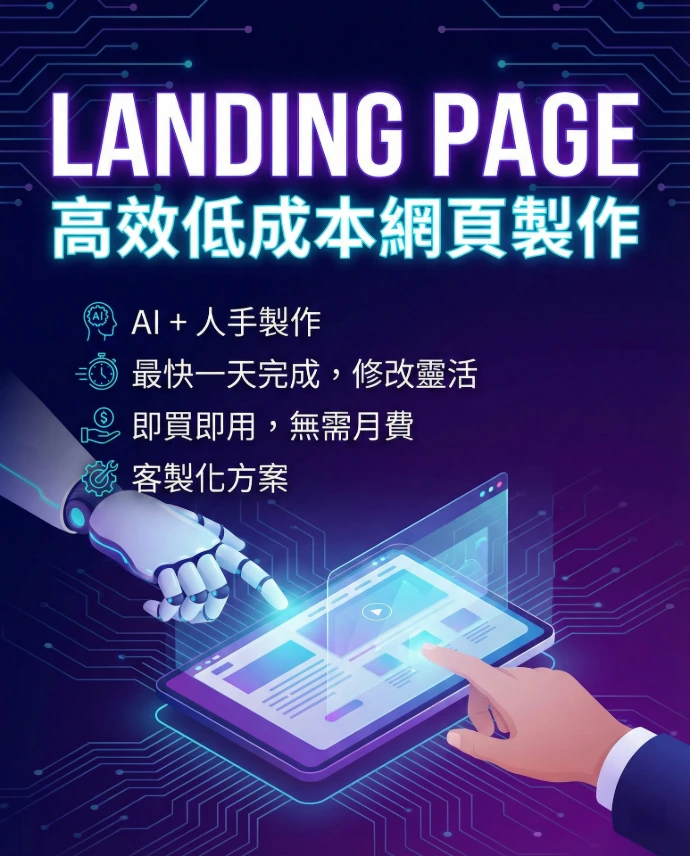
Website/AI-Powered Website Development Services
Using AI technology to quickly create Landing Pages and integrate various promotional needs, combined with AI automation procedures to efficiently reduce manual processing costs
Contact to Learn More Learn More
Click image to preview DEMO


What Subsidies and Funds Are Available in the Budget?
Now that we've covered the big picture, let's talk about what everyone cares about most — money. Running a business is costly, and transformation requires capital. This year's Hong Kong Budget AI policy has released an enormous flow of funding to guide the market and encourage businesses to upgrade.
1. HK$3 Billion "Artificial Intelligence Subsidy Scheme" — The government's HK$3 billion "AI Subsidy Scheme" has already approved nearly 30 R&D projects covering areas such as large language models, new materials, and biomedical research. While this primarily targets R&D institutions or enterprises with development capabilities, it will significantly strengthen local AI research and application. As these technologies trickle down, SMEs will be able to enjoy cheaper and more locally adapted AI tools.
2. HK$10 Billion "Innovation and Technology Industry Guidance Fund" — To boost the overall industry atmosphere, the government announced a HK$10 billion "Innovation and Technology Industry Guidance Fund" to attract market capital to invest in strategic emerging industries such as life health technology, AI and robotics, and future industries. The selection of fund managers is currently underway, with operations expected to launch within the year. This means more hot money will flow into AI-related innovative enterprises.
3. Major Upgrade to the BUD Special Fund (Direct Benefit for SMEs!) — This is the most direct good news for general SMEs! The "Special Fund for Developing Brands, Upgrading and Restructuring, and Expanding into Mainland Markets" (BUD Special Fund for short) has long been popular among businesses. This year, the government will inject HK$200 million into the fund and raise the "Easy Application" subsidy cap to HK$150,000 per application. Most critically, the government has explicitly stated it will provide more targeted subsidies for enterprises adopting AI applications! This means if you want to introduce AI customer service, AI marketing systems, or optimise internal data processes, applying for the BUD Fund now will yield a higher approval rate and better support than before.
Our Services
AI Automation Workflow Services

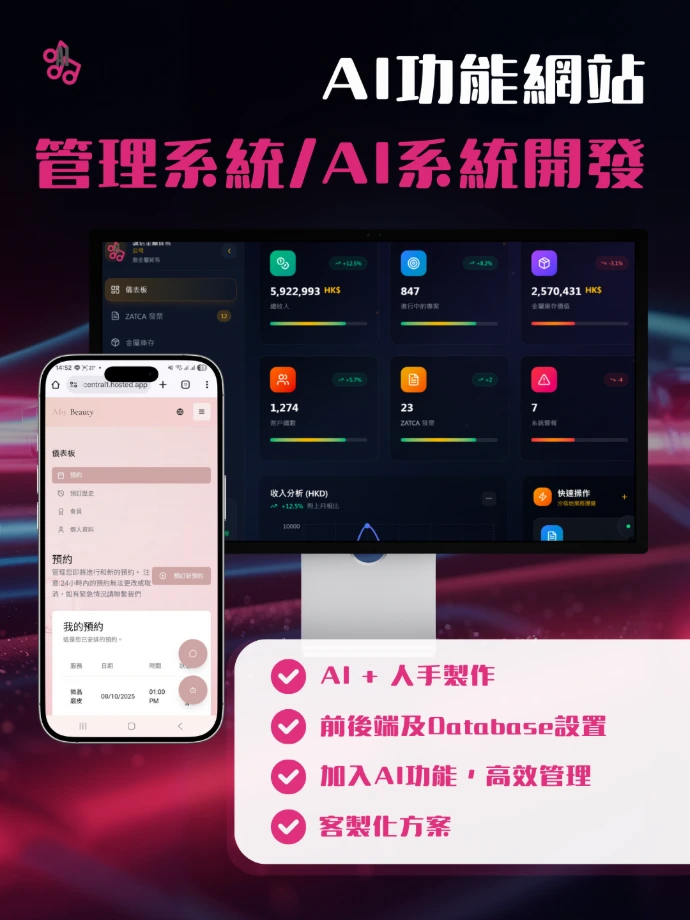
Website/Online Store/APP Development



What Practical Benefits Does the Budget Offer SMEs? AI Transformation Solves Three Key Pain Points
Beyond direct financial subsidies, this year's Hong Kong Budget AI policy also addresses actual operational pain points for SMEs through various supplementary measures.
Benefit 1: Solving the "Hard to Hire, Hard to Match" Problem — SMEs often struggle with recruitment, unsure where to find suitable employees. The Budget mentions that the Labour Department will use AI to optimise employment matching, providing better services to job seekers and employers. This means that when SMEs recruit through government platforms in the future, AI will help screen CVs more accurately, significantly reducing the time and manpower cost of finding talent.
Benefit 2: Free or Low-Cost AI Skills Upgrading for Existing Employees — Many business owners say: "I want to use AI, but my employees don't know how!" The government has heard this concern. The existing Employees Retraining Board (ERB) will be upgraded to the "Reskilling Authority", which will provide various "skills-based" training, including AI applications. This means you can encourage employees to attend these government-supported courses to enhance their competitiveness, allowing your team to master the latest AI tools for free or at very low cost.
Benefit 3: More Transparent Market Data to Support Business Decisions — SMEs typically don't have the vast market research teams that large enterprises enjoy. To address this information gap, the Census and Statistics Department will next month launch a brand new online interactive data service platform, integrating various types of statistical data to facilitate cross-topic analysis by businesses and citizens. Best of all, a "Natural Language Query Function" is expected to be added in the third quarter. This means you won't need to be a data analytics expert — just type a question as if chatting with ChatGPT, and you can query government statistics to help you decide where to open a store and who to target as customers!





AI Training for All: No More Fear of Not Finding AI Talent?
The final step of AI transformation is "people". To ensure Hong Kong has an endless supply of AI talent for businesses to hire, the Budget has invested heavily in education and universal training.
1. HK$50 Million "AI Training for All" — The government will allocate HK$50 million to invite various public bodies, together with technology companies and universities, to organise AI application learning courses, seminars, and competitions. This is not only to enhance the skills of students and youth, but also targets the general public, with the aim of popularising awareness and application of AI at all levels of society, and teaching everyone to use AI responsibly. As the overall AI literacy of society improves, the internal resistance SMEs face when implementing digital transformation will be greatly reduced.
2. HK$2 Billion to Advance Digital Education in Primary and Secondary Schools — The Quality Education Fund has reserved HK$2 billion to advance digital education in primary and secondary schools, launching school-based AI education projects and providing AI training for teachers. This is laying the groundwork for Hong Kong's talent pool for the next decade.
3. 27 New STEAM Degree Places at Tertiary Institutions — Over three academic years starting from 2025/26, funded universities will add a total of 27 new STEAM-related bachelor's degree programmes, covering AI, creative industries, data science, and more. From the 2027/28 academic year onwards, AI-related programmes will be prioritised for inclusion in the "Targeted Subsidy Scheme for Designated Professions/Sectors". The mandatory IT module in VTC Higher Diploma programmes will also cover AI applications. These policies guarantee that in the coming years, Hong Kong will see a large batch of professionally AI-trained graduates entering the workforce, making it much easier for SMEs to hire young talent with hands-on AI capabilities.
Conclusion: What Should SMEs Do Now?
This Hong Kong Budget AI policy clearly signals that Hong Kong is moving towards "digital intelligence" and "new industrialisation". For SMEs, the question is no longer "should we use AI" but rather "how to use government resources to help us adopt AI".
We recommend that all business owners and entrepreneurs take three steps: First, review which internal processes can be automated (e.g., customer service, marketing copy, basic data processing); Second, closely monitor the specific AI-targeted subsidy application details of the BUD Special Fund and make use of the HK$150,000 "Easy Application" cap to upgrade your systems; Third, encourage employees to participate in the AI practical courses that will soon be offered by the "Reskilling Authority". As long as you know how to leverage available resources, your business will absolutely stand out in this AI wave!
About the author
99AIcreator AI Services & Applications Consultant, helping SMEs with AI transformation. Dedicated to translating complex AI technology into practical productivity tools for businesses. Specialising in providing Hong Kong SMEs with tailored AI adoption strategies, employee skills training, and government funding application advice, helping businesses reduce costs, improve efficiency, and achieve AI transformation with ease in the digital era.
Contact Us / Get a Quote
Contact us on WhatsApp:  / Inquiry +852 59216804
FAQ: Frequently Asked Questions on Hong Kong Budget AI Policy
Q1: I am a traditional retail SME. Does this AI policy directly benefit me? A1: Yes! The most direct benefit is the BUD Special Fund, which has been injected with HK$200 million and explicitly states it will provide more targeted subsidies for enterprises adopting AI applications. You can use this funding (with an "Easy Application" cap of HK$150,000) to introduce AI inventory management systems or AI customer service robots to reduce operating costs.
Q2: I heard the government will help train employees' AI skills. Is that true? A2: Yes. The Employees Retraining Board will be upgraded to the "Reskilling Authority", which will provide "skills-based" training including AI applications. This means SME owners can leverage government resources to let existing employees learn AI tools, enhancing the overall team's competitiveness.
Q3: Is the government itself using AI? Is it just empty talk? A3: The government is being very proactive this time. It has already established an "AI Efficiency Enhancement Unit" and allocated HK$100 million to introduce industry-leading technology to accelerate the government's digital transformation. For example, the Labour Department will use AI to optimise employment matching, and the Transport Department will build a traffic management platform integrating big data and AI — these will genuinely improve public service levels.
Q4: I want to find some government macro data to make business decisions. Does the AI policy help? A4: It helps greatly. The Census and Statistics Department will soon launch a brand new online interactive data service platform to facilitate cross-topic analysis by businesses. A "Natural Language Query Function" is also expected to be added in the third quarter. In the future, you won't need to know complex data software — just query in a conversational way to easily access commercial data and support your decision-making.
Q5: Is Hong Kong's local AI computing power sufficient to support future industrial development? A5: Currently, Hong Kong's overall computing capacity has reached 5,000 petaFLOPS (floating-point operations per second). In addition, the government is accelerating the Sheung Shui Data Park project (providing 250,000 square metres of floor space), which will provide strong infrastructure support for future AI data and computing power needs.
(The content of this article is based on the latest release information from February 2026. AI technology evolves rapidly, and specific features are subject to the latest official announcements.)